|

From Famous Atheists Give Their Testimonies– by Reverend
Leroy Koopman, Pastor, Reformed Church. Used here
by permission. Formerly published in The Church
Herald, and Moody Monthly, November, 1975. One hundred
twenty philosophers, scientists, social scientists and religious leaders met last year in New York and signed a document called
the Humanist Manifesto II. (He means about 1974). In
4,000 words the Manifesto outlines a program for the salvation of mankind—a salvation to be experienced in this life
only, and a salvation to be accomplished entirely without the help of God. No deity will save us; we must save ourselves. Priding
itself on being free of religious dogmatism, it defends the right to birth control, abortion, divorce, sexual promiscuity,
and euthanasia. It is signed by such notable people as Isaac Asimov,
author; Dr. Francis Crick, discoverer of the structure of the DNA molecule; B.F. Skinner, Harvard psychologist; and
Rabbi Mordecai M. Kaplan, founder of the Jewish Reconstructionist Movement. The Humanist Manifesto II brought to mind a question asked by a college student in a bull session; Why is it when
people get educated they become atheists? Someone in that bull session
answered by pointing out that some of the world greatest intellectuals were, or are, Christian believers, and that the basic
premise of his question was incorrect. Nevertheless, the question
is bothersome, since many famous, rich and intelligent people are either atheists or agnostics. Is it really, as the Bible says, very foolish to disbelieve in God? Some of these famous and educated people who advocate humanism instead of theism, seem far from
foolish. Without trying to answer the question ourselves, without
entering into any theological arguments, without overtly defending our own faith, let us simply give thoughtful consideration
to what some of the world’s atheists have said about themselves and the success of their faith. Let us make just one requirement: we want to hear their testimonies, not in their young and brash
years, but in their mature years, after they have had the opportunity to view their lifetime from a high peak and a broad
perspective.
|
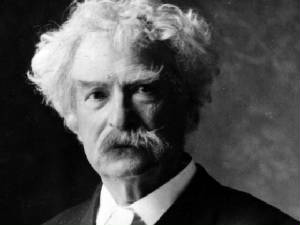
| Mark Twain (1835-1910) |
Mark Twain (1835-1910) Samuel Langhorne Clemens,
better known by his pen name, Mark Twain, attained worldwide fame as both a writer and a lecturer. It was the opinion of Ernest Hemingway that modern American literature begins with Huckleberry
Finn. Children
from seven to seventy continue to delight not only in the Adventures of Tom Sawyer, and Huck, but also in the adventures of
A Connecticut Yankee in King Arthur’s Court, The Celebrated Jumping Frog of Calaveras County, The Prince and the Pauper,
and many more. Mark
Twain was an atheist. In his autobiography he gave his personal testimony about his view of life: “A myriad of men are born; they labor and sweat
and struggle for bread; they squabble and scold and fight; they scramble for little mean advantages over each other.
Age creeps upon them
and infirmities follow; shames and humiliations bring down their prides and their vanities. Those they love are taken from them, and the joy
of life is turned to aching grief. The burden of pain, care, and misery, grows heavier year by year. At length ambition is dead, pride
is dead, vanity is dead; longing for release is in their place. It comes at last – the only unpoisoned gift earth ever had for them— and they vanish from a world where
they were of no consequence; where they achieved nothing, where they were a mistake and a failure and foolishness; where they left no sign that they had ever existed
– a world that
will lament them a day and forget them forever” (Autobiography, Vol. II, p. 37). The testimony of an atheist.
|
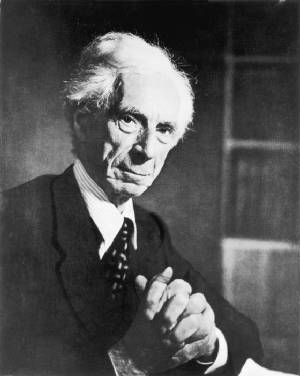
| Bertrand Russell (1872-1970) |
Bertrand Russell (1872-1970) Bertrand Russell came from one of England’s most distinguished families, and
he added considerable luster to the family reputation. He first gained attention with his book Principles of Mathematics
(1903) and seven years later published with Alfred North Whitehead a book which opened a new era in the study of the principles
of mathematics and philosophy, Principia Mathematica. More than forty books followed, on such divergent subjects as
philosophy, education, politics, and sex. In 1950 Russell received the Nobel Prize for literature and was
described as a “defender of humanity and freedom of thought. He lectured at Cambridge, Harvard, the University
of Peking, the University of Chicago, and the University of California. Late in life, in the early 1960 he again came
to the forefront of public notice by leading pacifist demonstrations against nuclear weapons. Bertrand Russell was an atheist. Bertrand
Russell also made a testimony. We
find his evaluation of life expressed in a letter to Lowes Dickinson: “Why should you suppose I think it foolish
to wish to see the people one is fond of? What else is there to make life tolerable? We stand on the shore of an ocean, crying to
the night and the emptiness; sometimes a voice answers out of the darkness. But it
is a voice of one drowning; and in a moment the silence returns." (Autobiography, p. 287). The
testimony of an atheist.
|
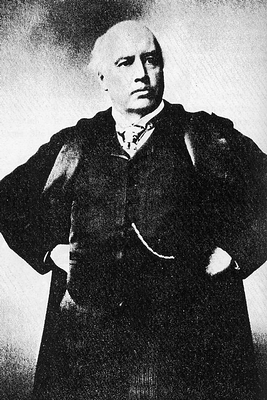
| Robert G Ingersoll (1833-1899) |
Robert G Ingersoll (1833-1899) Robert G. Ingersoll was a lawyer, politician,
and writer. Most of all, he was an evangelist for atheism.
With the possible exception of Madelyn Murray O’Hair, no
popular lecturer has ever attacked Christianity so forcefully, widely, continuously, and effectively. Robert Ingersoll’s personal testimony is remarkably like that of Bertrand Russell.
As he stood at the grave of his brother and gave an oration, he
said, “Death is a narrow vale between the cold and barren peaks of two eternities. We cry aloud and the only answer is the wailing echo of our cry.” The testimony of an atheist.
|
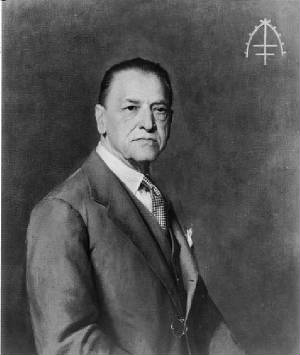
| W. Somerset Maugham (1874-1965) |
W. Somerset Maugham (1874-1965) W. Somerset Maugham was one of the most popular British writers of this century. Best known for his semi-autobiographical novel, Of Human Bondage, he wrote a dozen novels and more
than 150 short stories. Sometimes
ignored by the critics, he was loved by the reading public. He died at ninety-one,
an immensely famous and wealthy man, but embittered against his ex-wife and embroiled in a lawsuit with his daughter. W. Somerset
Maugham was an atheist. Near his life's end he wrote: “When I look back on my life…it
seems to me strangely lacking in reality. It may be that my heart, having found rest nowhere,
had some deep ancestral craving for God and immortality which my reason would have no truck with.” (quoted by columnist
Norman Ross, The Chicago Daily News, January 26th, 1964). The testimony of an atheist.

|
| George Bernard Shaw (1856-1950) |
George Bernard Shaw (1856-1950) Those who enjoyed the musical, My Fair Lady, have George Bernard Shaw to thank. His play Pygmalion (1912) was the basis for that modern musical.
Pygmalion is just one of more than fifty plays written by
Shaw. Some of his better-known works are Saint Joan, The Devil’s Disciple, Caesar and Cleopatra, and Androcles
and the Lion. He used the drama as a vehicle for social reform, vying against slum landlords, war, and the oppression
of women. In 1925 George Bernard Shaw was awarded the Nobel Prize for literature. George Bernard Shaw was
an atheist. Here is his personal testimony, penned near the end of his life in, Too True to Be
Good: “The science to which I pinned my faith is bankrupt. Its counsels which should have established the millennium have led directly to the suicide of Europe.
I believed
in them once…In their name I helped destroy the faith of millions of worshippers in the temples of a thousand creeds.
And now they look at me and
witness the great tragedy of an atheist who has lost his faith. The testimony of an atheist.
LET US SHARE just one more personal testimony. It was written by a man of immense intellect, great ambition, and genuine literary
achievement; also a man who underwent great personal
suffering and gross miscarriages of justice. "For
I am already on the point of being sacrificed; the time of my departure has come. I have fought the good fight, I have finished the race, I have kept the faith. Henceforth there is laid up for me the crown of righteousness, which the Lord, the righteous judge, will award to me on that Day, and not only to me but also to all who have loved his appearing. THE TESTIMONY OF A BELIEVER IN THE LORD JESUS CHRIST (The Apostle Paul – New Testament, book of 2 Timothy 4:6-8)
|