By faith Abraham, when he was called to go out into a place which he should after receive
for an inheritance, obeyed; and he went out, not knowing whither he went.
By
faith he sojourned in the land of promise, as in a strange country, dwelling in tabernacles with Isaac and Jacob, the heirs
with him of the same promise:
For he looked for a city which hath foundations,
whose builder and maker is God. Hebrews 11:8-10
I also like the Robert Jamieson,
A.R. Fausset, and David Brown commentary -- http://www.ccel.org/ccel/jamieson/jfb.toc.html .
31. sweet influences—the joy diffused by spring, the time when the Pleiades
appear. The Eastern poets, Hafiz, Sadi, &c., describe them as "brilliant rosettes." Gesenius translates: "bands"
or "knot," which answers better the parallelism.
But English Version agrees better
with the Hebrew. The seven stars are closely "bound" together (see on Job 9:9). "Canst thou bind or loose the tie?" "Canst thou loose the bonds by which the constellation Orion
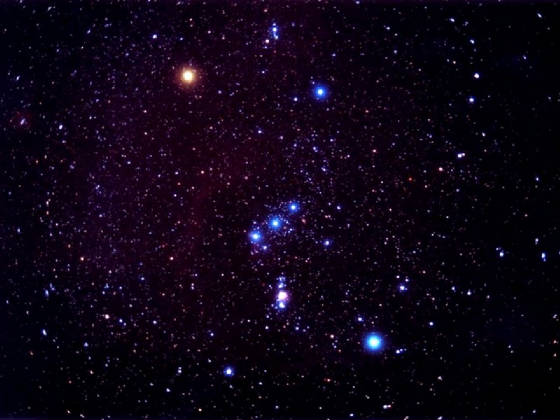
(represented in the East as an impious giant chained to the sky) is held fast?" (See on Job 9:9).
32. Canst thou bring forthfrom their places
or houses (Mazzaloth, 2Ki 23:5, Margin; to which Mazzaroth here is equivalent)
into the sky the signs of the Zodiac at their respective seasons—the twelve lodgings in which the sun successively stays,
or appears, in the sky?
Arcturus—Ursa Major. his sons?—the three stars in his tail.
Canst thou make them appear in the sky? (Job 9:9). The great and less Bear are
called by the Arabs "Daughters of the Bier," the quadrangle being the bier, the three others the mourners.
33. ordinances—which regulate the alternations of seasons, &c. (Ge :22) .dominion—controlling influence of the heavenly bodies, the sun, moon, &c., on the earth (on the tides,
weather) (Ge 1:16; Ps 136:7-9).
Job 9:9. maketh—rather, from the Arabic, "covereth up." This accords
better with the context, which describes His boundless power as controller rather than as creator [Umbreit]. Arcturus—the
great bear, which always revolves about the pole, and never sets.
The Chaldeans and Arabs, early
named the stars and grouped them in constellations; often travelling and tending flocks by night, they would naturally do
so, especially as the rise and setting of some stars mark the distinction of seasons.
Brinkley,
presuming the stars here mentioned to be those of Taurus and Scorpio, and that these were the cardinal constellations of spring
and autumn in Job's time, calculates, by the precession of equinoxes, the time of Job to be eight hundred eighteen years after
the deluge, and one hundred eighty-four before Abraham.
Orion—Hebrew, "the fool"; in Job
38:31 he appears fettered with "bands." The old legend represented this star as a hero, who
presumptuously rebelled against God, and was therefore a fool, and was chained in the sky as a punishment; for its rising
is at the stormy period of the year.
He is Nimrod (the exceedingly impious rebel) among the Assyrians;
Orion among the Greeks. Sabaism (worship of the heavenly hosts) and hero-worship were blended in his person.
He first subverted the patriarchal order of society by substituting a chieftainship based on conquest (Ge 10:9, 10).
Pleiades—literally,
"the heap of stars"; Arabic, "knot of stars."
The various names of this constellation
in the East express the close union of the stars in it (Am 5:8).
chambers of the south—the
unseen regions of the southern hemisphere, with its own set of stars, as distinguished from those just mentioned of the northern.
The true structure of the earth is here implied.
Wikipedia, the free encyclopedia --
http://en.wikipedia.org/wiki/Pleiades(star_cluster):
In astronomy,
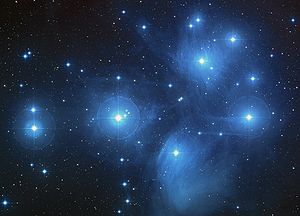
the Pleiades, or seven sisters, (Messier object 45) are an open star cluster in the constellation of Taurus.
It is among the nearest star clusters to Earth and is the cluster most obvious to the naked eye in the night sky.
Pleiades has several meanings in different cultures and traditions.
The Pleiades are a prominent sight in winter in the Northern Hemisphere and in summer in the Southern
Hemisphere, and have been known since antiquity to cultures all around the world, including the Māori, who call them
Matariki, and Australian Aborigines, the Persians, who called them Parveen/parvin
and Sorayya, the Chinese, the Maya (who called them Tzab-ek), the Aztec (Tianquiztli), and the Sioux of North America. The Babylonian star cataloguesname them
MUL.MUL or "star of stars", and they head the list of stars along the ecliptic, reflecting the fact that they were
close to the point of vernal equinox around the 23rd century BC.
Some Greek astronomers considered them to be a distinct constellation, and they are mentioned by Hesiod, and in Homer's
Iliad and Odyssey.
They are also mentioned
three times in the Bible (Job 9:9 and 38:31, as well as Amos 5:8).
The Pleiades (Krittika) are particularly revered in Hindu mythology as the six mothers of the war god Skanda, who
developed six faces, one for each of them.
Some
scholars of Islam suggested that the Pleiades (Al thuraiya) are the Star in Najm which is mentioned in the Quran.
A Spitzer image of the Pleiades in infrared light, showing the associated dust. Credit: NASA/JPL-Caltech
They have long been known to be a physically related group of stars rather than any
chance alignment.
The Reverend John Michell calculated
in 1767 that the probability of a chance alignment of so many bright stars was only 1 in 500,000, and so correctly surmised
that the Pleiades and many other clusters of stars must be physically related.[4]
When studies were first made of the stars' proper motions,
it was found that they are all moving in the same direction across the sky, at the same rate, further demonstrating that they
were related.
Charles Messier measured the position of the cluster and included it as M45 in his catalogue of comet-like objects, published in 1771.
Along with the Orion Nebula and the Praesepe cluster, Messier's inclusion of the Pleiades has been noted as curious, as most of
Messier's objects were much fainter and more easily confused with comets—something which seems scarcely possible for
the Pleiades.
One possibility is that Messier simply wanted to
have a larger catalogue than his scientific rival Lacaille, whose 1755 catalogue
contained 42 objects, and so he added some bright, well-known objects to boost his list.[5]
Seek him that maketh the seven stars and Orion,
and turneth the shadow of death into the morning,
and maketh the day dark with night:
that calleth for the waters of the sea,
and
poureth them out upon the face of the earth:
The
LORD is his name: -- Amos 5:8