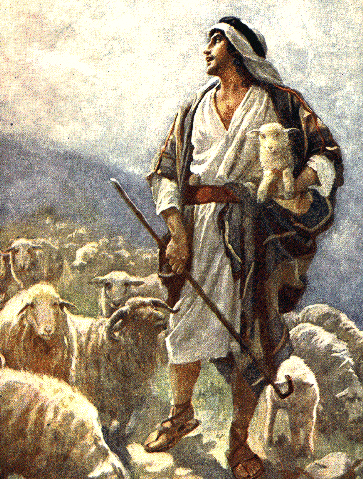
We humans badly need our souls restored and to be led in the paths
of righteousness. But we need the great Shepherd, who is Jesus Christ, to lead us in the way.
We cannot shepherd ourselves. King David says, “The Lord is my shepherd.”
Jesus alone IS LORD. He alone knows the way. We must be diligent to join his flock. Choose him as your Lord, Savior
and Shepherd today.
Commentary by Robert Jamieson,
A.R. Fausset, and David Brown - 1871 -
Psalm 23:1-6. Under a metaphor borrowed from scenes of pastoral life, with which David was familiar, he describes
God's providential care in providing refreshment, guidance, protection, and abundance, and so affording grounds of confidence
in His perpetual favor.
1. Christ's relation to His people
is often represented by the figure of a shepherd (Joh 10:14; Heb 13:20; 1Pe 2:25; 5:4), and therefore the opinion that He
is the Lord here so described, and in Ge 48:15; Ps 80:1; Isa 40:11, is not without some good reason.
2. green pastures—or, "pastures of tender grass," are mentioned, not
in respect to food, but as places of cool and refreshing rest. Still waters—literally, "waters of "stillness,"
whose quiet flow invites to repose. They are contrasted with boisterous streams on the one hand, and stagnant, offensive pools
on the other.
3. To restore the soul is to revive or quicken
it (Ps 19:7), or relieve it (La 1:11, 19). --Paths of righteousness-those of safety, as directed by God, and pleasing to Him.
- for his name's sake—or, regard for His perfections, pledged for His people's welfare.
4. In the darkest and most trying hour God is near. -- the valley of the shadow of death is a ravine
(in Israel) overhung by high precipitous cliffs, filled with dense forests, and well calculated to inspire dread to the timid,
and afford a covert to beasts of prey. While expressive of any great danger or cause of terror, it does not exclude the greatest
of all, to which it is most popularly applied, and which its terms suggest. -- thy rod and thy staff—are symbols of
a shepherd's office. By them he guides his sheep.
5-6. Another
figure expresses God's provided care. -- a table—or, "food," anointing -- oil—the symbol of gladness,
and the overflowing - cup—which represents abundance—are prepared for the child of God, who may feast in spite
of his enemies, confident that this favor will ever attend him. This beautiful Psalm most admirably sets before us, in its
chief figure, that of a shepherd, the gentle, kind, and sure care extended to God's people, who, as a shepherd, both rules
and feeds them. The closing verse shows that the blessings mentioned are spiritual.
The end of the JFB commentary.
In the Gospel of John, Jesus
says: 10:1-21:
Verily, verily, I say unto you, He that
entereth not by the door into the sheepfold, but climbeth up some other way, the same is a thief and a robber.
2 But he that entereth in by the door is the shepherd of the sheep.
3 To him the porter openeth; and the sheep hear his voice: and he calleth
his own sheep by name, and leadeth them out.
4
And when he putteth forth his own sheep, he goeth before them, and the sheep follow him: for they know his voice.
5 And a stranger will they not follow, but will flee from him: for they
know not the voice of strangers.
6 This
parable spake Jesus unto them: but they understood not what things they were which he spake unto them.
7 Then said Jesus unto them again, Verily, verily, I say unto you,
I am the door of the sheep.
8 All
that ever came before me are thieves and robbers: but the sheep did not hear them.
9 I am the door: by me if any man enter in, he shall be saved, and shall
go in and out, and find pasture.
10 The
thief cometh not, but for to steal, and to kill, and to destroy: I am come that they might have life, and that they might
have it more abundantly.
11 I am the good
shepherd: the good shepherd giveth his life for the sheep.
12 But he that is an hireling, and not the shepherd, whose own the sheep are not, seeth the wolf coming,
and leaveth the sheep, and fleeth: and the wolf catcheth them, and scattereth the sheep.
13 The hireling fleeth, because he is an hireling, and careth not for the
sheep.
14 I am the good shepherd, and
know my sheep, and am known of mine.
15
As the Father knoweth me, even so know I the Father: and I lay down my life for the sheep.
16 And other sheep I have, which are not of this fold: them also I must
bring, and they shall hear my voice; and there shall be one fold, and one shepherd.
17 Therefore doth my Father love me, because I lay down my life, that I might take it
again.
18 No man taketh it from me, but
I lay it down of myself. I have power to lay it down, and I have power to take it again. This commandment have I received
of my Father.
19 There was a division
therefore again among the Jews for these sayings.
20
And many of them said, He hath a devil, and is mad; why hear ye him?
21 Others said, These are not the words of him that hath a devil. Can a devil open the
eyes of the blind?
The Bible speaks of “sanctification.”
Psalm 23:3 is a good illustration:
He restoreth my soul: he leadeth me in the paths of righteousness for his name's sake.
There are three aspects of this.
First, God “imputes” or deems us completely righteous when we believe on Jesus Christ (see Romans
chapter 4 below).
Second, Psalm 23:3-4 shows the process
by which he transforms our present lives to good.
Third, there
is the time we die, and then the resurrection, when we become actually, completely, perfect without sin. Verse
5-6 speaks of this time.
God said of Abraham in Genesis 15:6:
And he believed in the LORD; and he (God) counted it
to him for righteousness. It is imperative we be “reckoned” or “counted” as righteous
-- that righteousness be “imputed” to us by true faith in Jesus Christ, that we may have everlasting life.
Romans
4
1 What shall we say then that Abraham our
father, as pertaining to the flesh, hath found?
2
For if Abraham were justified by works, he hath whereof to glory; but not before God.
3 For what saith the scripture? Abraham believed God, and it was counted unto him for
righteousness.
4 Now to him that worketh
is the reward not reckoned of grace, but of debt.
5
But to him that worketh not, but believeth on him that justifieth the ungodly, his faith is counted for righteousness.
6 Even as David also describeth the blessedness
of the man, unto whom God imputeth righteousness without works,
7 Saying, Blessed are they
whose iniquities are forgiven, and whose sins are covered.
8 Blessed is the man to whom the Lord will not impute sin.
9 Cometh this blessedness then upon the circumcision only, or upon the uncircumcision
also? for we say that faith was reckoned to Abraham for righteousness.
10 How was it then reckoned? when he was in circumcision, or in uncircumcision? Not in circumcision,
but in uncircumcision.
11 And he received
the sign of circumcision, a seal of the righteousness of the faith which he had yet being uncircumcised: that he might be
the father of all them that believe, though they be not circumcised; that righteousness might be imputed unto them also:
12 And the father of circumcision to them who are not of the circumcision
only, but who also walk in the steps of that faith of our father Abraham, which he had being yet uncircumcised.
13 For
the promise, that he should be the heir of the world, was not to Abraham, or to his seed, through the law, but through the
righteousness of faith.
14 For if they
which are of the law be heirs, faith is made void, and the promise made of none effect:
15 Because the law worketh wrath: for where no law is, there is no transgression.
16 Therefore it is of faith, that it might
be by grace; to the end the promise might be sure to all the seed; not to that only which is of the law, but to that also
which is of the faith of Abraham; who is the father of us all,
17 (As it is written, I have made thee a father of many nations,) before him whom he believed, even God,
who quickeneth the dead, and calleth those things which be not as though they were.
18 Who against hope believed in hope, that he might become the father of many nations,
according to that which was spoken, So shall thy seed be.
19
And being not weak in faith, he considered not his own body now dead, when he was about an hundred years old, neither yet
the deadness of Sarah's womb:
20 He staggered
not at the promise of God through unbelief; but was strong in faith, giving glory to God;
21 And being fully persuaded that, what he had promised, he was able also
to perform.
22 And therefore it was imputed
to him for righteousness.
23 Now it was
not written for his sake alone, that it was imputed to him;
24 But for us also, to whom it shall be imputed, if we believe on him that raised up Jesus our Lord from
the dead;
25 Who was delivered for
our offences, and was raised again for our justification.
See my page -- They Came To Jesus! --Three men who embrace Jesus as Savior.